Contracts
Service Agreements with expert lawyers
Fixed-fee legal help from Australia's top-rated online law firm, with expert lawyers guiding you every step of the way.

100,000+ businesses helped


Get a free quote
We'll get back to you




What's included
Formalise service arrangements with a clear, binding agreement.
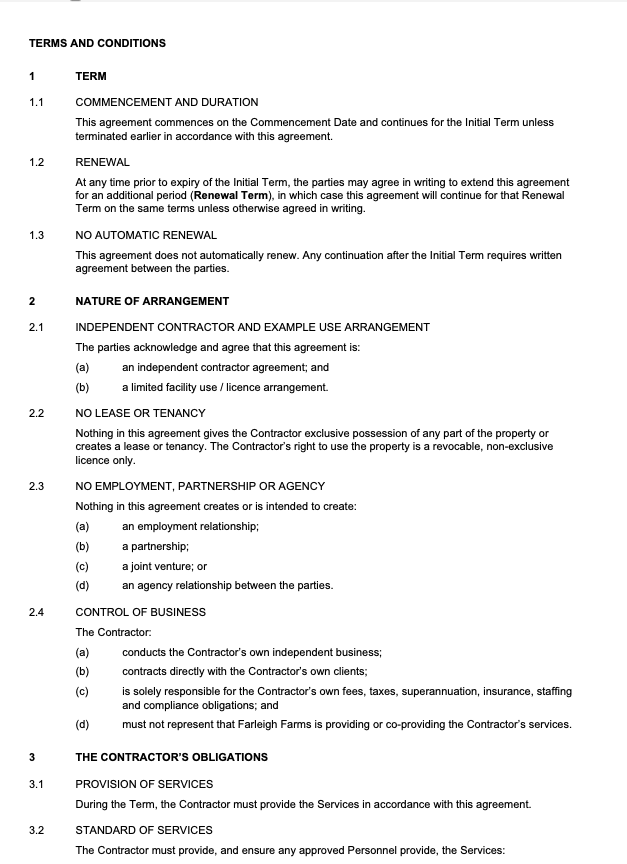
A custom service agreement that protects your business and outlines key terms.
- Phone/Video Consultation
- Document (Word/PDF Format)
- Complimentary Amendment
Project
Service Agreement
Status
CompletePrepared by

Alex Solo
Senior Lawyer
FAQs
Frequently asked questions
Unsure about how we work? We have gathered the most common questions for your convenience.
A Service Agreement is the core contract between a service provider and their client. In plain English, it sets out what services will be provided, how payment works, what each party is responsible for, and what happens if something changes or goes wrong.
You are most likely to need one if your business provides services to clients, especially where the work is customised, higher-value, ongoing or business-to-business. This could include consulting, creative services, marketing, software development, professional services, trades, coaching, agency work or any project where scope, timing, payment and risk need to be clearly documented.
A Service Agreement is especially useful where misunderstandings could become expensive. For example, a client may expect extra work to be included, delay payment, provide information late, dispute deliverables, or assume they own intellectual property you intended to retain. A written agreement gives both sides a clearer framework before work begins.
It is also worth distinguishing a Service Agreement from standard Terms and Conditions. A Service Agreement is usually better suited to bespoke or project-based services, while Terms and Conditions may be more appropriate for standardised, repeatable or online transactions.
A good Service Agreement should cover the commercial and legal terms that matter for your client relationship. This usually includes what services will be provided, what the client will pay, when payment is due, what each party needs to do, and how the arrangement can be changed or ended.
The exact clauses depend on how your business delivers services. Common areas include:
- Commercial terms: fees, payment timing, deposits, milestones, late payments and expenses.
- Delivery terms: scope of services, deliverables, timelines, client responsibilities, revisions and variations.
- Legal protections: confidentiality, intellectual property, warranties, liability limits and Australian Consumer Law considerations.
- Exit and dispute terms: termination rights, cancellation, suspension of services, dispute resolution and governing law.
A one-off project may need detailed deliverables, milestones and acceptance criteria. An ongoing retainer may need monthly inclusions, notice periods, reporting obligations and rules around out-of-scope work. A business that works across multiple projects may benefit from a Master Service Agreement with separate Statements of Work for each engagement.
A Service Agreement protects your business by setting clear rules before work begins. It helps define what services are included, what is outside scope, when you should be paid, what the client needs to provide, who owns the work product, and what happens if the arrangement needs to change or end.
One of the biggest risks for service providers is unclear expectations. A client may assume extra revisions, additional deliverables, faster turnaround times or ongoing support are included, even if that was never part of the original deal. A well-drafted Service Agreement can reduce this risk by clearly setting out the scope of work and including a process for variations, so extra work can be approved and charged properly.
It can also help protect cash flow. Clear payment terms, invoicing rules, milestone payments, late payment consequences and suspension rights can make it easier to manage clients who delay payment or fail to provide the information you need to complete the work.
Without a clear agreement, disputes can become harder to resolve. You may end up arguing about what was promised, when payment was due, whether the client can cancel, who owns the intellectual property, or whether you are responsible for losses outside your control. A tailored Service Agreement gives you a clearer position if something goes wrong and helps both sides understand their rights and responsibilities from the start.
You can use a template, and it may be useful as a starting point. It can help you understand the types of clauses that often appear in service contracts and give you a basic structure to work from.
The limitation is that a template does not know how your business actually works. It may not reflect your pricing model, project process, approval workflow, client obligations, subcontracting arrangements, intellectual property position, industry risks or cancellation process.
This matters because different service businesses can have very different risks. A consultant, software developer, creative agency, trades business and NDIS provider may all need Service Agreements, but the clauses should not necessarily look the same. Some businesses may also need a Statement of Work, Terms of Trade, Website Terms and Conditions or Privacy Policy alongside their Service Agreement.
That is why many businesses look for a middle ground. You may not want a traditional law firm charging open-ended hourly rates, but you also may not want to rely on a generic template for an important client contract. A tailored Service Agreement is usually the safer option where your services are valuable, customised or central to your business revenue.
Sprintlaw helps startups get legal support in a simple, flexible way. Instead of the traditional law firm model, we offer an easier online process designed for busy founders who want practical advice without unnecessary complexity.
To get started, you can request a free quote and tell us a bit about what your business needs. From there, we’ll guide you through the next steps and connect you with one of our lawyers, who can work with you by phone, email or video call.
We keep the process straightforward from start to finish, so you can get the legal help you need while staying focused on building your business.
Sprintlaw offers fixed-fee pricing, so you know the cost upfront before any work begins. That means no surprise bills and no uncertainty about how much your legal support is going to cost.
The exact price will depend on the type of help your startup needs, whether that’s setting up the right documents, reviewing an agreement or getting advice on a specific issue. We can provide a free quote based on your business and what you’re looking for.
If you expect to need legal help on a more regular basis, we also offer membership options that can support your business as it grows.
Sprintlaw is an online law firm that works with startups across Australia, The UK and New Zealand. That means you can get legal support from our team no matter where your business is based.
Because our service is fully online, it’s designed to be flexible and convenient for founders. You can work with our lawyers remotely and get the help you need in a way that fits around your business.
From quote to delivery in three simple steps
Getting quality legal help for your business has never been easier or more affordable.
Get a free quote
Our legally trained consultants will prepare a fixed-fee quote for you.
Accept online
Accept your fixed-fee quote and e-sign our engagement letter.
Speak with a lawyer
Our expert lawyers will talk you through your project via phone, video call or whatever suits.
Get a free quote
Our legally trained consultants will prepare a fixed-fee quote for you.
Accept online
Accept your fixed-fee quote and e-sign our engagement letter.
Speak with a lawyer
Our expert lawyers will talk you through your project via phone, video call or whatever suits.


We've helped over 100,000 Australian businesses
From tech startups in Sydney to restaurants in Alice Springs, we consistently deliver a 5 star service.

“Can’t speak highly enough of my experience with Sprintlaw - quality advice, fast and efficient responsiveness and a professional product.”

Alex Wickert
MD, Adapt Leadership
“I’m so glad I used Sprintlaw - it was easy, affordable and their lawyers gave top quality advice. I could tell they really cared about my business.”

Emmy Samtani
Founder, Kiindred
“They’ve helped us tremendously and are seriously knowledgeable and honest. Couldn’t recommend the crew at Sprintlaw more!”

Amit Tewari
CEO, Soul Burger
Industry leaders


















Not sure where to start?
We can help.
Book a phone call with our team to get started.
Need help now?
1800 730 617