Intellectual Property
IP Licences with expert lawyers
Fixed-fee legal help from Australia's top-rated online law firm, with expert lawyers guiding you every step of the way.

100,000+ businesses helped


Get a free quote
We'll get back to you




What's included
Grant IP rights on your terms with a customised licence agreement.
You receive a tailored IP licence that protects your unique creations.
- Phone/Video Consultation
- Document (Word/PDF Format)
- Complimentary Amendment
Project
IP Licence
Status
CompletePrepared by

Alex Solo
Senior Lawyer
FAQs
Frequently asked questions
Unsure about how we work? We have gathered the most common questions for your convenience.
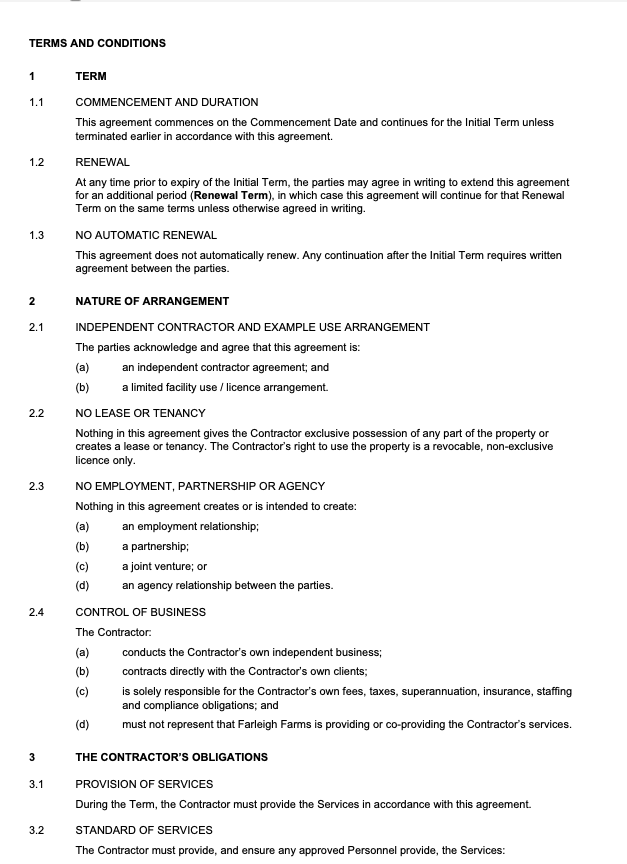
An IP Licence Agreement is a legal agreement that lets someone else use your intellectual property on agreed terms, without transferring ownership of it. In other words, you still own the IP, but you are giving another person or business permission to use it in a controlled way.
You are most likely to need one when you want to commercialise your IP without giving it away. That might be because you are licensing software to customers, allowing another business to use your brand, giving someone access to content or creative assets, or expanding through distributors, collaborators or other business partners.
The key benefit is control. A licence lets you keep ownership while setting the rules around how your IP can be used, where it can be used, for how long, and on what commercial terms. If your goal is to keep the asset but generate revenue from it, an IP licence is often the right structure.
It is also important not to confuse licensing with selling. If you want to transfer ownership of the IP entirely, you may need an IP Assignment Deed instead. But if you want to retain ownership and simply allow use, an IP Licence is usually the better fit.
A strong IP Licence Agreement should clearly set out what IP is being licensed, who can use it, how they can use it, where they can use it, how long the arrangement lasts, and what they need to pay. It should also make clear whether the licence is exclusive, non-exclusive or sole, and whether the licensee can sublicense the IP to anyone else.
Depending on the type of IP, the agreement may also need to deal with practical issues like royalties, approval rights, confidentiality, quality control, ownership of improvements, reporting obligations, restrictions on misuse, and what happens when the arrangement ends. These details matter because they are often where licensing relationships become unclear if they are not documented properly.
For example, if you are licensing software, you may want detailed rules around copying, access, support and resale. If you are licensing branding, trade marks or other brand assets, quality control and brand use restrictions become much more important. That is why some businesses may be better served by a more specific document like a Software Licence Agreement or a Copyright Licence Agreement.
The challenge is not just listing clauses in a document. It is making sure the agreement matches your commercial model and gives you the level of control your business actually needs. That is usually where generic templates start to fall short.
Usually, the issue is not that something goes wrong immediately. The problem is that informal permission can become risky later, when there is real value in the relationship and the parties no longer see things the same way.
That might happen when a licensee starts using your IP more broadly than you expected, disputes arise about exclusivity or territory, fees are not paid properly, or the relationship ends and it is unclear what use can continue. Without a written agreement, those issues can quickly turn into expensive arguments about what was actually agreed.
Even if you still legally own the IP, ownership alone does not answer the commercial questions. A written licence is what usually deals with the day-to-day rules around use, restrictions, sub-licensing, confidentiality, approvals, duration and termination. If those terms are not documented properly, you may be left trying to reconstruct the arrangement after the relationship has already broken down.
That is why putting the right agreement in place early is usually much easier than trying to untangle an informal arrangement later. If the real goal is to let someone use your IP while you stay in control of it, documenting that properly from the start can save a lot of stress.
You can use a template, and in some cases it can be a useful starting point. It may help you understand the kinds of issues an IP licence is supposed to cover and give you a basic structure to work from.
The problem is that templates are usually not built around your actual IP, your commercial goals or the risks in the relationship. They do not know whether you are licensing software, branding, course content, creative assets or business know-how. They also do not know whether you need exclusivity, royalties, territorial limits, usage restrictions, sublicensing controls or approval rights.
That means a template can look fine on paper while still missing the issues that matter most to your business. In licensing, the real risk is often not whether you have a document at all, but whether the document gives you enough clarity and control once the other party starts using your IP in the real world.
For many businesses, the better option is a middle ground - something more reliable than a generic template, without the unpredictability of a traditional law firm model. Depending on what you are licensing, that might mean a tailored IP Licence or a more specific agreement like a Software Licence Agreement.
Sprintlaw offers fixed-fee pricing, so you know the cost upfront before any work begins. That means no surprise bills and no uncertainty about how much your legal support is going to cost.
An IP Licence with Sprintlaw typically costs between $500 and $1,500. The exact price will depend on the type of help your startup needs - we can provide a free quote based on your business and what you’re looking for.
If you expect to need legal help on a more regular basis, we also offer membership options that can support your business as it grows.
Sprintlaw helps startups get legal support in a simple, flexible way. Instead of the traditional law firm model, we offer an easier online process designed for busy founders who want practical advice without unnecessary complexity.
To get started, you can request a free quote and tell us a bit about what your business needs. From there, we’ll guide you through the next steps and connect you with one of our lawyers, who can work with you by phone, email or video call.
We keep the process straightforward from start to finish, so you can get the legal help you need while staying focused on building your business.
Sprintlaw is an online law firm that works with startups across Australia. That means you can get legal support from our team no matter where your business is based.
Because our service is fully online, it’s designed to be flexible and convenient for founders. You can work with our lawyers remotely and get the help you need in a way that fits around your business.
From quote to delivery in three simple steps
Getting quality legal help for your business has never been easier or more affordable.
Get a free quote
Our legally trained consultants will prepare a fixed-fee quote for you.
Accept online
Accept your fixed-fee quote and e-sign our engagement letter.
Speak with a lawyer
Our expert lawyers will talk you through your project via phone, video call or whatever suits.
Get a free quote
Our legally trained consultants will prepare a fixed-fee quote for you.
Accept online
Accept your fixed-fee quote and e-sign our engagement letter.
Speak with a lawyer
Our expert lawyers will talk you through your project via phone, video call or whatever suits.


We've helped over 100,000 Australian businesses
From tech startups in Sydney to restaurants in Alice Springs, we consistently deliver a 5 star service.

“Can’t speak highly enough of my experience with Sprintlaw - quality advice, fast and efficient responsiveness and a professional product.”

Alex Wickert
MD, Adapt Leadership
“I’m so glad I used Sprintlaw - it was easy, affordable and their lawyers gave top quality advice. I could tell they really cared about my business.”

Emmy Samtani
Founder, Kiindred
“They’ve helped us tremendously and are seriously knowledgeable and honest. Couldn’t recommend the crew at Sprintlaw more!”

Amit Tewari
CEO, Soul Burger
Industry leaders


















Not sure where to start?
We can help.
Book a phone call with our team to get started.
Need help now?
1800 730 617